
Multi-accounting
Running many accounts, without them being read as one
Every platform worth having accounts on is trying to work out which of them belong to the same person. Four signals give it away, and only one of them is the IP address.









Multi-accounting is exactly what it sounds like: holding more than one account on a service that would rather you held one. Agencies do it because the accounts belong to different clients. Sellers do it because a marketplace is a different business in each country. Affiliates, researchers and anyone with a second brand do it because one account cannot hold two jobs. The difficulty is never creating the accounts — it is that the platform keeps joining them back together.
The problem
Four things link two accounts, and people usually only fix one
Almost everyone starts by changing their IP address, finds it did not work, and concludes the platform is unbeatable. In fact the address is the weakest of the four signals, and it is the only one a VPN touches.
Storage is the loudest. Two accounts opened in one browser share a cookie jar, local storage, IndexedDB, service workers and a cache. Any of those is somewhere a site can leave a marker and read it back from the other session — which is why incognito and separate browser profiles both fail: they were designed to keep your own data tidy, not to defeat someone looking for a link.
The device is next, and it is what most people are missing. Canvas rendering, WebGL's reported vendor and renderer, audio processing, screen dimensions, CPU cores, memory, timezone, language list — together they identify a machine nearly as reliably as a cookie, without setting one. Twenty accounts reporting the same GPU string are twenty accounts on one computer.
The network is the familiar one: the exit address, whether it sits on a datacenter range, and whether the real address leaks around the proxy through WebRTC. And behaviour is the last — the same phone number, the same recovery email, the same payment card, or ten accounts that only ever act between nine and five on weekdays. No browser can fix that fourth one, and this page will not pretend otherwise.
Isolation
One: a real boundary between sessions
In Argus every account is a profile, and every profile starts from its own directory — its own storage, its own cache, its own cookie jar. This is a filesystem boundary rather than a setting inside one browser, which is the difference between a partition and a promise.
Session restore is disabled, so a previous run cannot resurface in a new one. The proxy is applied at the network layer rather than through an extension a page can detect. And a default block list covers the remote-access ports that sites probe to spot automation. Two profiles running side by side on one laptop have nothing in common to find.
Fingerprints
Two: a different machine, that still looks like a machine
The instinct is to block everything. It is the wrong one: a browser that reports no canvas, no GPU, no fonts and a timezone that contradicts its language is not anonymous — it is the most memorable visitor of the day. Coherence beats concealment, and it is the whole design of the fingerprint system.
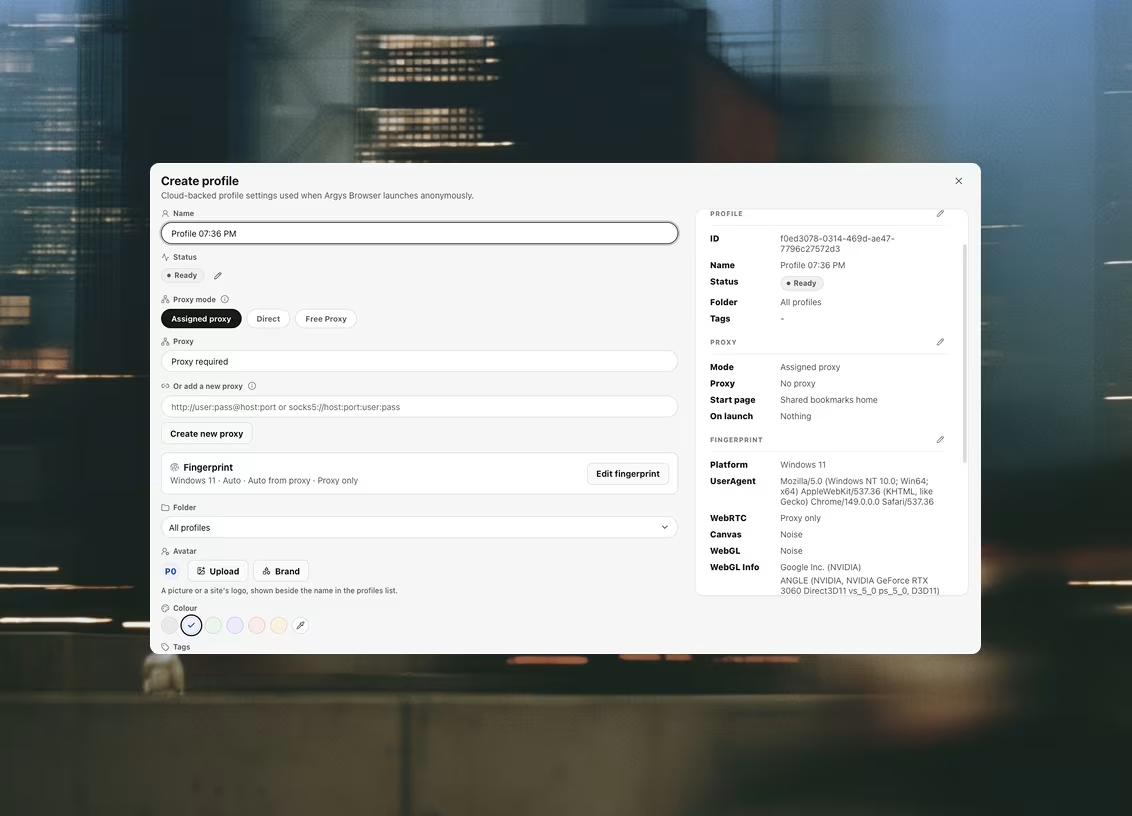
Argus generates a hardware identity per profile as one set: platform, CPU cores, memory, screen, timezone and languages, with the user-agent and its UA-CH metadata generated to match. Canvas, WebGL — including the reported vendor and renderer — and audio are applied in the renderer, beneath the page. A script reads the spoofed value because it is the only value present, not because a wrapper intercepted the real one. Each surface can run as real, noise, off, or a value you pin yourself, and a one-click re-roll produces a fresh identity while keeping the rest of the configuration.
That last distinction is the reason Argus ships its own Chromium instead of automating someone else's. A wrapper can be found by anything that checks whether a function has been replaced; a value applied below the page cannot.
Proxies
Three: an exit per account, and a check before you trust it
Argus does not sell bandwidth and does not route your traffic. Bring proxies from whichever provider you already use, keep them in a shared library, and assign them per profile. HTTP and SOCKS5 both work, including the authenticated SOCKS5 variant plain Chromium cannot speak at all — Argus runs the RFC 1929 handshake inside the browser process rather than popping a proxy authentication dialog at you.
Health checks report the egress IP, the country and the latency, and flag an exit sitting on a datacenter network while naming the provider behind it. The behaviour that matters most is what happens when a check fails: the launch is blocked. A proxy that quietly falls back to your own connection is how a carefully separated set of accounts ends up sharing one real address for an afternoon — which is precisely the link you were avoiding. WebRTC leak protection is applied as browser policy to every profile, beneath the JavaScript layer, so it is not a toggle anyone can forget.
Profiles · Teams
Four: and then there are a hundred of them
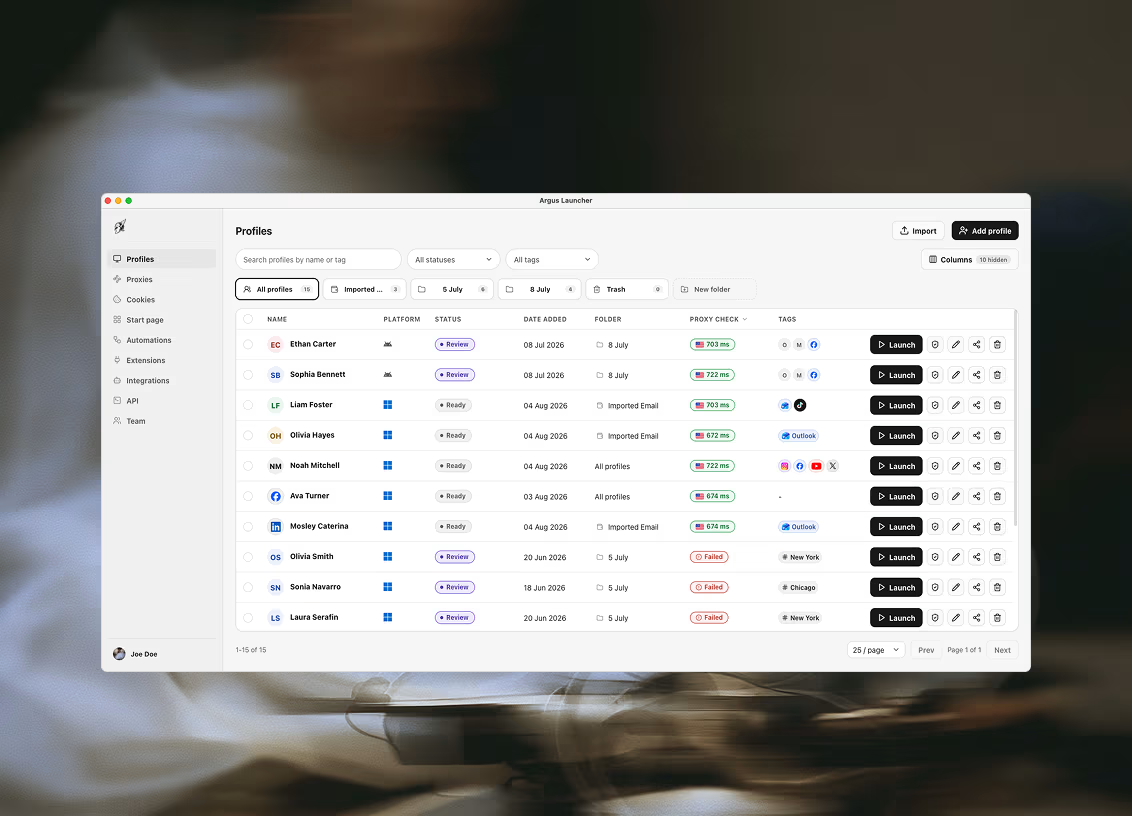
Separation stops being the hard part surprisingly quickly. What remains is the list: folders, tags, custom status labels and notes, with search, filters and paging, plus bulk launch, bulk edit and bulk delete. Profiles arrive by CSV import and leave by CSV export, and delete is soft — Trash first, restore available.
When more than one person is involved, a workspace shares one pool of profiles, proxies and cookie sets rather than trading files. Every write touches a single row, so two people working the same list at once cannot overwrite each other. And cookie sets mean a colleague can open an account without ever being told its password.
The honest part
What an anti-detect browser cannot do
It cannot fix the fourth signal. If the accounts share a phone number, a recovery email, a payment method or a funding wallet, they are linked by records that never touch the browser, and no fingerprint setting reaches them.
It is also not permission. Some services allow several accounts outright, some allow them on approval, and some forbid them — that is between you and their terms, and it differs per service. Argus separates accounts you are entitled to run. Our acceptable use policy says which uses we deliberately do not prohibit, and which ones we do, in plainer words than most of this industry manages.
And it is not a way back from a ban. An account that is gone is gone; a fresh profile is a fresh account, not a restored one. Anyone telling you differently is selling something that does not work.

Ready to run profiles at scale?
Download Argus for Mac or Windows and start free with 5 profiles.